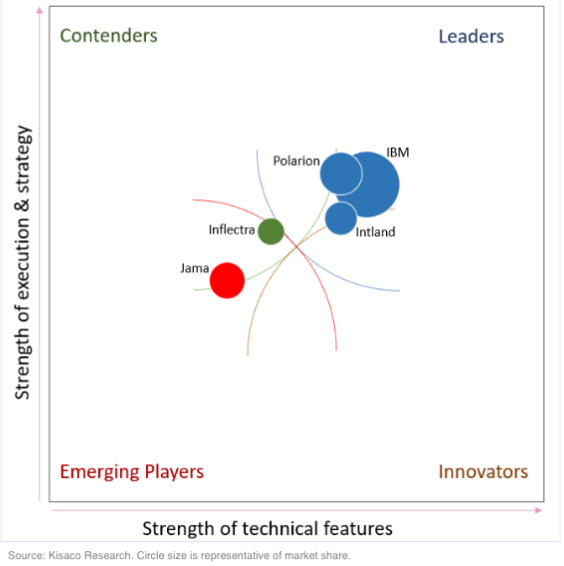
recent market report from Forrester evaluated the benefits of integrating your tools, and your teams, to extend the benefits of traditional application lifecycle management (ALM) functions with Engineering Lifecycle Management (ELM) tools. In fact, Kisaco Research recently named IBM a market leader, in a study of competitive ELM tools. Markets across many industries are poised to emerge from the pandemic smarter and more resilient with the help of smarter software and product development tools. Whether you’re developing cutting-edge medical devices or delivering on public infrastructure projects, engineering and development teams require a single source of requirements data and connected global supplier networks for safe, successful outcomes. Delivering on a commitment to provide continuous improvements to its market-leading engineering software tools like DOORS Next,IBM Engineering is announcing another release of enhancements across the ELM portfolio. Explore: Managing Complexity for Medical Device Development What’s new in ELM 7.02? The latest release of V7.0.2 remains focused on making the platform easier to use by integrating your requirements, systems design and modeling with workflow and test management tools for improved traceability across the entire product lifecycle. This offers and unparalleled advantage to manual processes or single-task solutions. Users can expect to see enhancements in the UX, security, verification and validation testing, industry compliance, performance and scalability, reporting, and integration. Read: Seven reasons to invest in ELM
IBM’s continued commitment to improving the management of systems and software development projects is helping customers optimize their engineering processes to be more resilient, agile, and competitive. What’s next in 2021? As development teams face pressures to deliver increasingly complex products, the ability to scale becomes essential. Market leaders are taking steps toward digital transformation by investing in their software management systems and development processes, creating a bedrock for optimized software and product development to occur. IBM Engineering can help you reimagine your development processes to enhance productivity, lower costs, and improve quality, so you can emerge more competitive and more prepared to respond to dynamic market changes. Reach out if you think we can help.
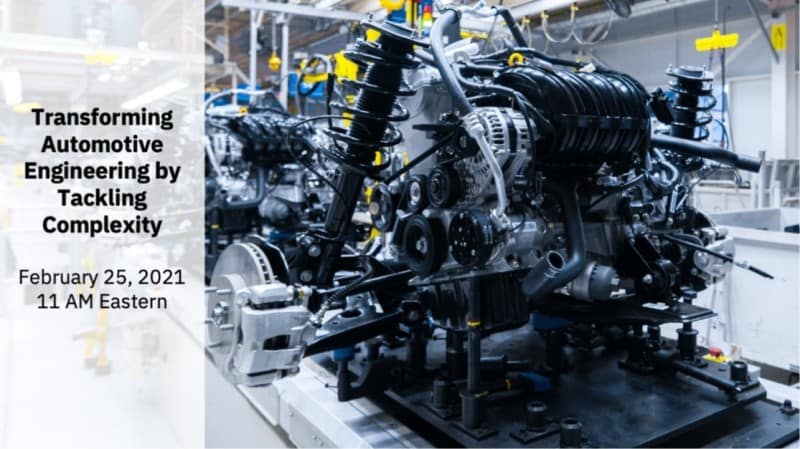
SAE: Transforming Automotive Engineering by Tackling Complexity
Thurs, Feb 25, 2021 at 11:00AM ET
Electrification and ADAS are accelerating product complexity to unmanageable levels. The nexus of this complexity is where software and electrical engineering converge. The problem with current processes and tools is they’re disconnected and discontinuous, creating challenges in single engineering domains and across domains.
This webinar examines how to enable a transformation of automotive engineering through an integrated multi-domain tool chain that supports industry imperatives and offers increased efficiency, automation, and traceability. It discusses the partnership of Siemens and IBM and how they have worked together to connect cross-domain processes, information, and tools, especially between systems, electrical, and software engineering.
Join us to learn how to:
Simplify wiring, reduce ECUs, & increase functionality & flexibility Optimize vehicle cost & weight Iimprove quality while reducing warranty costs driven by software & electrical engineering incompatibilities Establish traceability to drive a design path for safety-critical functions Enable a shared & common set of requirements Leverage & extend existing investments efficiently
Looking for help to get started with IBM DOORS NG?
IBM Rational DOORS Next Generation is a web-based requirements management solution for complex software and systems engineering environments. This playlist is for anyone who wants to learn about IBM Rational DOORS Next Generation. The topics are at a high level, providing an overview of key use cases and product features.
The IBM Continuous Engineering and Collaborative Lifecycle Management solutions have a rich heritage in helping teams around the world to develop products and applications faster, in a more dependable way, and at a higher quality. Over time we have come to see that the biggest challenges — and where we can offer the most help — are with teams addressing their engineering lifecycle: software engineering, certainly, and also systems engineering and the many other engineering disciplines that are necessary to create the amazing products and systems that power our economy today. We are addressing Engineering Lifecycle Management, and we are renaming our products to make that more obvious.
Why are we renaming the products?
Two reasons: to make it easier to identify each product’s primary function by its name, and to communicate our focus and investment in helping teams to implement effective Engineering Lifecycle Management.
When will I see the new names?
The products are being renamed in a phased manner. Web pages will start referencing the new names in the coming months. The v6.0.6.1 products and product documentation (released today!) retain the old names, and we intend to adopt the new names in the follow-on release.
Why are we renaming the products in a phased manner?
This phased approach gives you (and us!) time to adjust to the new names. For example, if you have written your own documentation or training materials for your customers, you can update and use them with the Jazz v6.0.6.x release family while you make plans for more significant changes when you adopt the follow-on release.
What products are being renamed?
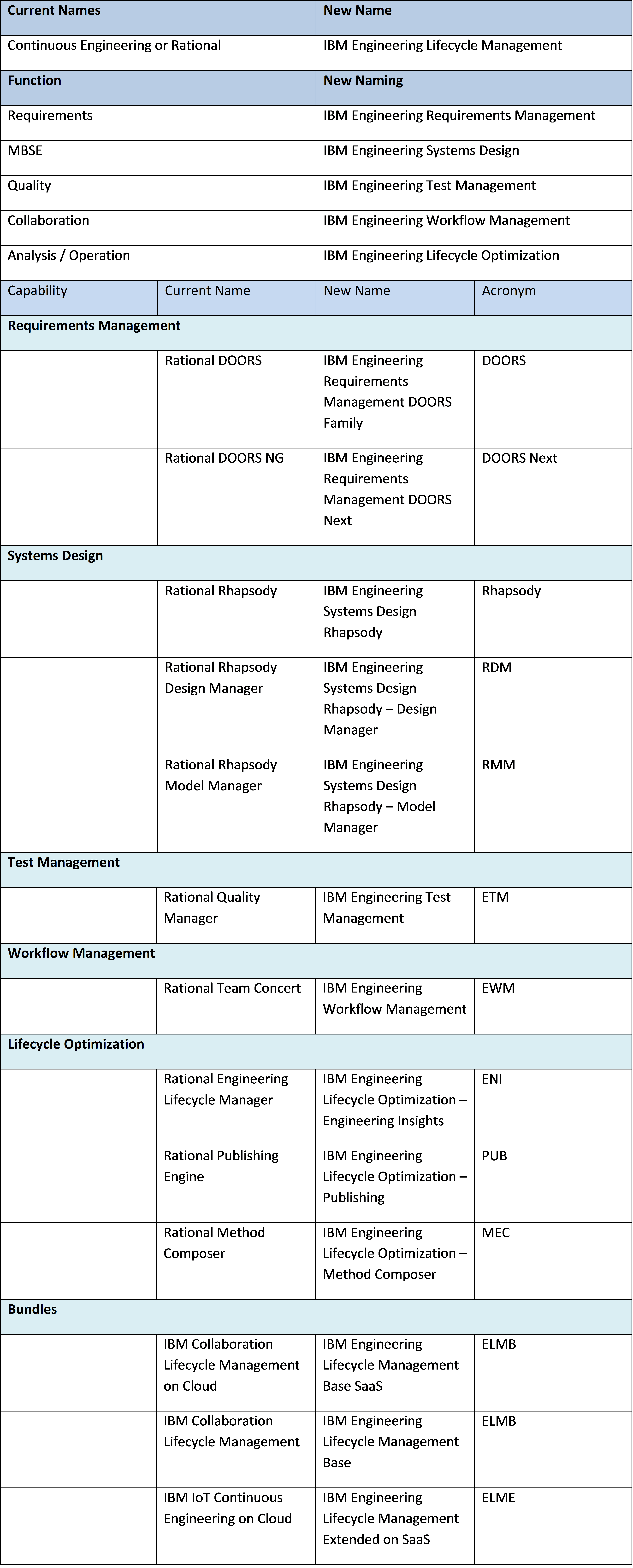
Here are the major changes:
IBM Engineering Lifecycle Management (ELM) – formerly CLM and CE, IBM Engineering Requirements Management DOORS Family (DOORS) – formerly Rational DOORS IBM Engineering Requirements Management DOORS Next (DOORS Next) – formerly Rational DOORS Next Generation (DNG) IBM Engineering Requirements Quality Assistant (RQA) – formerly IBM Requirements Quality Assistant (RQA) IBM Engineering Workflow Management (EWM) – formerly Rational Team Concert (RTC) IBM Engineering Test Management (ETM) – formerly Rational Quality Manager (RQM) IBM Engineering Systems Design Rhapsody (Rhapsody) – formerly Rational Rhapsody IBM Engineering Systems Design Rhapsody – Design Manager (RDM) – formerly Rational Design Manager (RDM) IBM Engineering Systems Design Rhapsody – Model Manager (RMM) – formerly Rational Model Manager (RMM) IBM Engineering Lifecycle Optimization (ELO) – new umbrella name for offerings that surround and extend ELM IBM Engineering Lifecycle Optimization – Engineering Insights (ENI) – formerly Rational Engineering Lifecycle Manager (RELM) IBM Engineering Lifecycle Optimization – Publishing (PUB) – formerly Rational Publishing Engine (RPE) IBM Engineering Lifecycle Optimization – Method Composer (MEC) – formerly Rational Method Composer (RMC) IBM Engineering Lifeycle Optimization – Integration Adapters (IA-product) – formerly Rational Lifecycle Integration Adapters (RLIA for product)
Are the products changing when the names change?
They are the same market-leading engineering lifecycle management products. Even the part numbers are the same. As you would expect, future enhancements will be introduced in releases of the newly-named products.
We recognize that product development is getting more complex while the product lifecycle is shrinking, customers are becoming more technically savvy and demanding, and compliance and regulatory requirements are growing. We want to make sure our product naming does not compound this complexity, and we believe this renaming will promote simplicity and clarity over time.
IBM® Engineering Lifecycle Management (ELM) integrates ELM products to provide a complete set of applications for software or systems development. ELM includes IBM Engineering Requirements Management DOORS® Next (DOORS Next), IBM Engineering Requirements Management DOORS (DOORS), IBM Engineering Workflow Management (EWM), and IBM Engineering Test Management (ETM), IBM Engineering Systems Design Rhapsody® – Model Manager (RMM), and IBM Engineering Lifecycle Optimization – Engineering Insights (ENI) with Jazz™ Team Server. This solution is designed for requirements analysts, developers, systems engineers, and testers.
The following diagram shows the development lifecycle that the solutions support. To see overviews of the applications that are represented in the image, click the boxes. For example, clickValidate and verify to see an overview of ETM.
To support the development lifecycle, ELM products let you link artifacts across applications, as shown in the following figure and examples: Figure 1. ELM connects analysts, developers, and testers
Requirements:
Requirements are implemented by iteration plans and validated by test plans.
Requirements are elicited, documented, elaborated, and validated by analysts. Their implementation progress is tracked in work items, and their correctness is validated by test cases.
Implementation:
Project managers and development managers use iteration plans to implement requirements in the context of a development schedule.
Team leads plan the iterations using iteration plans, where the work is divided further into tasks.
Developers work on defects that are submitted by testers as a result of test execution.
Testing:
The test team links requirements to test plans and test cases.
Testers link test cases to work items to ensure coverage of the implementation.
Testers run test cases and submit defects for test failures.
ELM integrates the work of analysts, developers, and testers by providing the following cross-application features:
Link between artifacts across applications: For example, you can link test cases to work items and requirements.
Hover over a link to see details about the link target: For example, testers can monitor the status of a defect that they reported to the development team.
Track status across projects by adding widgets from different applications to a dashboard: For example, you can add a widget that shows the defects that are blocking testers.
Jazz Team Server
The Jazz Team Server provides the foundational services, such as user management and license management, that enable the ELM applications to work together as a single logical server. In this way, the Jazz Team Server serves as an integration hub for the applications. After you install the ELMproducts, you install product license keys into the Jazz Team Server to permit access to the capabilities provided by the applications. For details about the topologies supported for new or upgraded installations, see Planning the deployment and installation.
Products and applications
For a detailed overview of the products and applications in ELM, see the following topics:
ELM products are developed transparently on the open and extensible Jazz platform. On Jazz.net, you can download the products and their milestones, track development schedules, join discussion forums, open enhancement requests, and interact with the product developers. To learn more about the products, see the developer-written articles in the Jazz.net library or the topics about complex deployment scenarios on the Deployment wiki.
More information
To learn more about ELM, see these resources:
ELM on Jazz.net: Learn about the new features, read the release notes, and download the binaries to install the solution.
ELM videos: These videos highlight the configuration management capabilities of the solution.
ELM sandbox: You can try a series of exercises in an online sandbox to learn more about a broad range of capabilities across the application development lifecycle.
ELM on Jazz.net: Learn about the new features, read the release notes, and download the binaries to install the solution.
ELM demo series: This set of recorded demonstrations offers a full lifecycle walk-through, and videos that highlight specific industry needs, in-depth tools, and practice topics.