
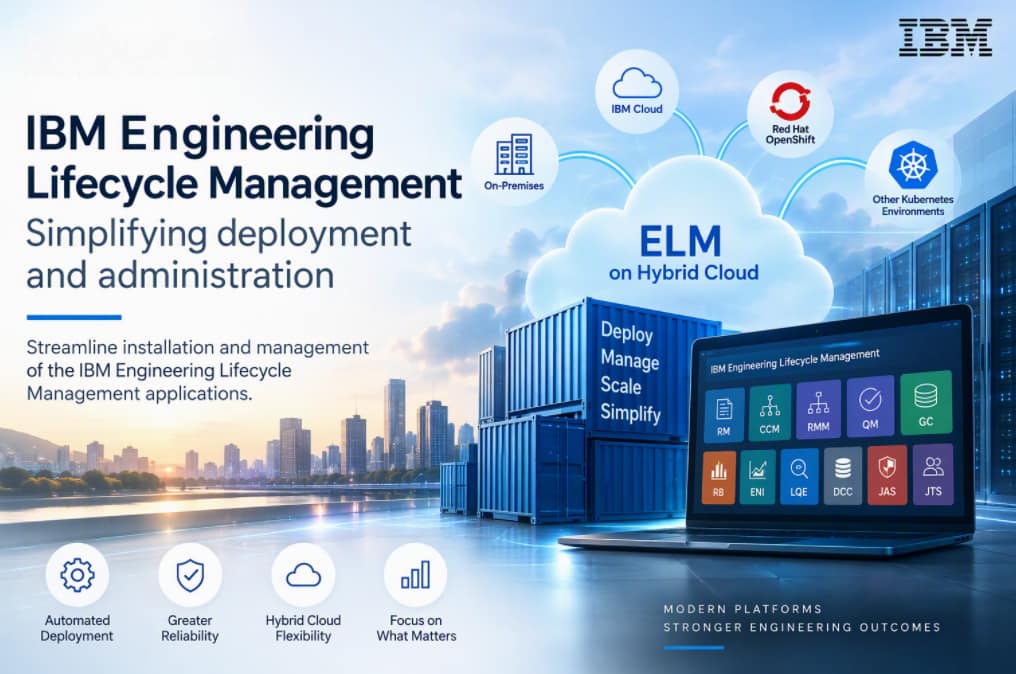
How containerized deployment can streamline installation, maintenance, and management of IBM ELM
Modern engineering organizations are under constant pressure to move faster while maintaining quality, security, reliability, and compliance.
At the same time, enterprise IT environments continue to become more complex. Applications may span on-premises infrastructure, private clouds, and public clouds, while skilled technical resources are increasingly focused on higher-value modernization and transformation initiatives.
This is where containerization and Kubernetes-based orchestration can make a meaningful difference.
Containers provide a more consistent way to package and deploy application workloads, while orchestration platforms such as Red Hat OpenShift Container Platform can help organizations manage those workloads across modern hybrid-cloud environments.
For IBM Engineering Lifecycle Management (ELM), IBM has introduced Engineering Lifecycle Management on Hybrid Cloud, combining containerized ELM applications with an operator designed to automate deployment and management. IBM describes the approach as providing automation for ELM deployments, greater control over scaling resources, and improved serviceability through consistent configuration, predictable behavior, and diagnostic data collection. [ibm.com], [ibm.com]
A More Modern Approach to ELM Deployment
Traditional enterprise software administration can involve considerable effort around installation, configuration, maintenance, troubleshooting, and infrastructure management.
ELM on Hybrid Cloud provides an alternative deployment model built around containers and an ELM operator.
According to IBM, each ELM application container is deployed in a separate Kubernetes pod, while the ELM operator manages the ELM application workload and associated Kubernetes resources within its namespace. [ibm.com]
The result is a deployment model that introduces greater automation into areas that have traditionally required significant administrative attention.
IBM specifically states that the Hybrid Cloud approach simplifies installation, maintenance, and upgrades, while providing automation for ELM deployment management and improved serviceability. [ibm.com]
What Can Be Automated?
The containerized ELM deployment model is designed to reduce the manual effort associated with managing an ELM environment.
The ELM application portfolio can include capabilities such as:
- Requirements Management (RM)
- Change and Configuration Management (CCM)
- Rhapsody Model Manager (RMM)
- Quality Management (QM)
- Global Configuration (GC)
- Report Builder (RB)
- Engineering Insights (ENI)
- Lifecycle Query Engine (LQE)
- Data Collection Component (DCC)
- Jazz Authorization Server (JAS)
- Jazz Team Server (JTS)
IBM’s Hybrid Cloud architecture couples ELM containers with an operator that provides automation for managing ELM deployments. IBM also highlights consistent configuration and diagnostic data collection as serviceability advantages of the approach. [ibm.com], [ibm.com]
For engineering organizations, this can shift more attention away from routine platform administration and toward the engineering processes and outcomes that ELM is there to support.
Hybrid Cloud Flexibility
One of the important aspects of this architecture is deployment flexibility.
IBM documentation identifies support for deploying Engineering Lifecycle Management on Hybrid Cloud across:
- Red Hat OpenShift Container Platform on-premises
- Red Hat OpenShift on IBM Cloud
- IBM Cloud Kubernetes Service
- Other OpenShift or Kubernetes services in private-cloud or on-premises environments [ibm.com]
This gives organizations options when designing an ELM architecture around their existing infrastructure and hybrid-cloud strategy.
Importantly, IBM notes that external and optional dependencies are customer-managed and that the operator manages the ELM application workload and related Kubernetes resources rather than every component of the surrounding environment. [ibm.com]
That distinction matters when planning an enterprise deployment.
Why This Matters for Engineering Organizations
For organizations already using ELM, the significance goes beyond simply putting software into containers.
The real opportunity is operational consistency and automation.
IBM describes ELM on Hybrid Cloud as providing automation for deployment management, the ability to provide additional resources as usage grows, and improvements in serviceability through consistent configuration, predictable behavior, and diagnostic-data collection. [ibm.com], [ibm.com]
That can help engineering and IT organizations establish a more standardized approach to operating an application lifecycle management platform across modern infrastructure.
The bigger picture
Engineering teams increasingly need platforms that can evolve alongside their development practices and infrastructure strategies.
Containerizing ELM and combining it with Kubernetes orchestration represents an important step in that direction. It brings modern deployment principles to the engineering lifecycle platform while giving organizations more flexibility in where that platform operates.
For enterprises balancing engineering velocity, governance, reliability, and infrastructure modernization, that can be a compelling combination.
Want to See It in Action?
Explore how IBM Engineering Lifecycle Management on Hybrid Cloud can simplify the deployment and administration of your ELM environment.
Book a live demo with an IBM expert
About IBM Engineering Lifecycle Management
IBM Engineering Lifecycle Management is a suite of interconnected applications supporting engineering and software-development lifecycle activities. IBM’s current documentation provides both traditional file-system installation and Hybrid Cloud deployment paths. [ibm.com], [ibm.com]
