
“What is our risk if the market moves right now?” It is a simple question with a demanding computational answer. Risk teams may need to run Monte Carlo simulations and other compute-intensive analytics quickly enough to inform pre-trade decisions, valuations and stress scenarios.
In a series of LinkedIn posts, I wrote about the growing compute needs of financial institutions and the role of high-performance computing in meeting them. The central point was that having compute capacity is only part of the problem. Teams also need to get the right work onto available resources and return results within the time their decisions allow.
The workload matters as much as the hardware
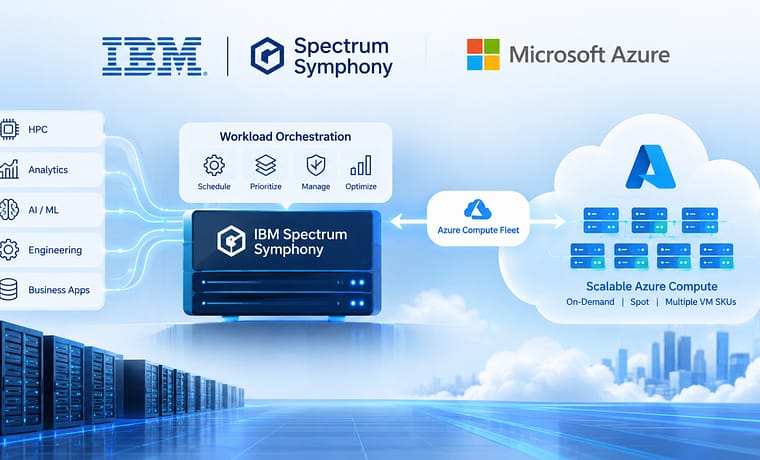
Financial analytics can involve many parallel calculations, shifting demand and multiple applications competing for shared infrastructure. A platform has to coordinate workloads and resources so that compute-intensive jobs can use available capacity without every application needing a separate, fixed environment.
IBM describes Spectrum Symphony as an application framework for distributed or parallel applications in a scaled-out grid environment. Its software manages resources and workloads in a cluster, dynamically assigning resources to applications as work is submitted. That makes workload orchestration a relevant part of the discussion for organizations running demanding financial computations.
Questions for financial and technology leaders
- How long does a representative risk or pricing workload take under normal and peak demand?
- Can the platform distribute parallel work across the resources available to it?
- How are competing applications prioritized when demand rises?
- Can teams see whether capacity is being used effectively?
- What service, security and resilience requirements must remain in place as workloads scale?
These questions help connect infrastructure choices to the actual decision cycle. Faster execution is valuable when it gives analysts and business leaders more time to assess scenarios and act. The right architecture depends on the workload, its data, the organization’s controls and the response time the business needs.
AI adds another dimension. Quantitative teams may run AI models alongside established analytics, increasing the importance of managing different workloads across shared compute resources. Leaders should evaluate the complete path—from submission and scheduling to results and operational review—rather than looking only at peak processor capacity.
Further reading: IBM Spectrum Symphony overview.
Newsletter
Imran's Insights
Perspectives to help your team navigate AI, software delivery, engineering and high-performance computing.