
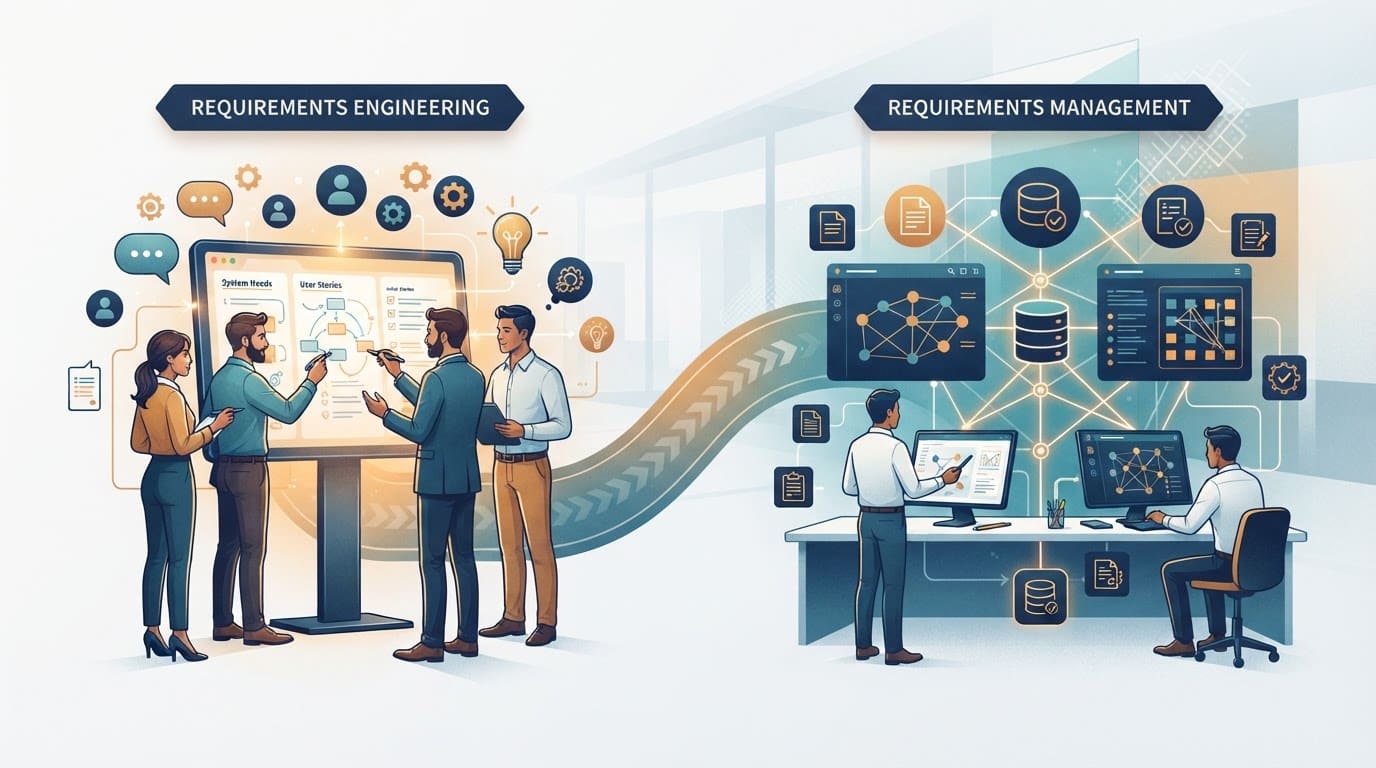
Requirements engineering and requirements management are closely related disciplines, and organizations often use the terms differently. A useful distinction is that requirements engineering focuses on discovering, analyzing, specifying, and validating what a system should do, while requirements management focuses on controlling and maintaining those requirements and their relationships as the system changes.
Both are needed. A team can produce excellent initial requirements but lose control of them during delivery. It can also manage a repository rigorously while storing requirements that were never properly understood.
What requirements engineering covers
Requirements engineering starts with a problem and stakeholder context. It includes eliciting needs, analyzing goals and constraints, resolving conflicts, defining system boundaries, allocating needs to components, writing requirements, and validating that they represent the intended outcome.
The discipline also considers interfaces, operational scenarios, risks, feasibility, and verification. Its quality depends on collaboration among users, product owners, systems engineers, developers, architects, and test specialists.
What requirements management covers
Requirements management maintains the approved information over time. It includes ownership, identifiers, status, reviews, approvals, baselines, traceability, change requests, versioning, reporting, and evidence that requirements were fulfilled.
Management activities help teams understand what changed, why it changed, who approved it, and what downstream work may be affected. They also support reuse across releases or product variants where the context is understood.
How the activities overlap
The boundary is not rigid. Analysis can continue after baseline approval. A change request may reveal that the original requirement was ambiguous. Verification can identify a missing stakeholder need. In each case, teams return to engineering activities and then update managed records.
A practical lifecycle therefore treats engineering and management as connected loops: discover and refine, agree and baseline, trace and deliver, evaluate change, and verify.
Example: a requirement changes
Suppose a system requirement changes after a supplier interface is finalized. Requirements engineering examines the rationale, operating scenario, feasibility, interface assumptions, and measurable acceptance criteria. Requirements management records the proposed revision, identifies linked design and test artifacts, routes the change for decision, updates the approved baseline, and makes the decision visible.
Without engineering analysis, the team may approve a poorly understood change. Without management controls, downstream teams may implement different interpretations.
Why tools matter
Tools support shared records, links, reviews, and history, but they cannot resolve unclear language or make a sound decision by themselves. Teams need conventions for artifact types, quality checks, trace links, roles, and change authority.
IBM DOORS Next supports requirements artifacts and relationships, while IBM ELM can connect requirements work with development, design, and test activities. IBM guidance describes using traceability links, attributes, filters, workflows, and dashboards to manage requirements. IBM documentation
Common misconceptions
One misconception is that requirements engineering ends when the specification is approved. In evolving products, requirements continue to be refined and verified through delivery. Another is that requirements management means change prevention. Effective management allows change while making impact, authority, and rationale visible.
A third misconception is that a tool installation equals process maturity. Tool setup should reflect a defined workflow, but teams still need training, ownership, and regular quality reviews.
Choosing where to improve
If stakeholders disagree on needs, improve elicitation, analysis, and validation. If teams cannot tell which statements are current, improve baselines, ownership, and change control. If testing cannot show coverage, improve verification planning and traceability. If changes create rework, examine both the quality of impact analysis and how decisions are communicated.
How IBM DOORS Next and ELM support the combined practice
DOORS Next can provide a structured environment for requirements artifacts, attributes, links, and reviews. ELM connects requirements with other engineering applications when configured for the program. That means teams can support both the creation and ongoing management of requirements in a connected lifecycle. Validate the supported integrations and features for the chosen product version and deployment.
Requirements engineering helps teams define the right system. Requirements management helps them keep that intent controlled and visible as the system evolves. Together they make requirements usable from discovery through verification.
Newsletter
Imran's Insights
Perspectives to help your team navigate AI, software delivery, engineering and high-performance computing.


